What Is Peptide Therapy? A Wellness Coach’s Guide to Evidence, Regulation and Safe Next Steps
What is peptide therapy? A coach’s guide to the four product categories, the latest FDA compounding developments, evidence gaps and where coaching fits.

In a nutshell
Peptide therapy means using peptides, short chains of amino acids, as treatments. In practice, the phrase covers FDA-approved peptide medicines, investigational compounds still in trials, compounded preparations from pharmacies, and products with no clear approval at all. For many of the peptides popular in wellness circles, compounding is not currently permitted, and human evidence is limited. Decisions about any peptide treatment belong with a licensed clinician.
If you work with a wellness coach, follow fitness creators or spend time in longevity communities online, you have probably heard someone mention peptide therapy. It is often described as the next big thing for recovery, energy, body composition or healthy aging. Clients ask coaches about it all the time, usually after hearing a friend’s story or watching a short video.
As coaches, we think it is important to answer those questions honestly, which starts with being clear about what peptide therapy actually is and where the evidence stands. This guide explains the term, the different categories of peptide products, what has changed in U.S. regulation recently, where human evidence is strong and where it is thin, and how coaching fits alongside, but never in place of, medical care.
What Is Peptide Therapy?
Peptides are short chains of amino acids, the same building blocks that make up proteins. The body uses many peptides as messengers: hormones such as insulin and oxytocin are peptides or peptide-based. Peptide therapy simply means using a peptide as a treatment.
The difficulty is that the phrase is extremely broad. As The Peptides Blog explains in its guide to why “peptide therapy” is such a broad term, the same words can describe a well-tested prescription medicine, an experimental compound still in clinical trials, a preparation made by a compounding pharmacy, or a product sold online with no matching approval or trial record. Each of these comes with very different levels of oversight and evidence.
So when a client says “I’m thinking about peptide therapy,” the most helpful first response is a question: which peptide, for what purpose, from where?
Why Peptide Therapy Has Become So Popular
Several forces have pushed peptides into the wellness spotlight at once. The success of GLP-1 based medicines for diabetes and weight management showed the public that peptide drugs can produce dramatic, well-documented results, and that halo has spread to the whole category. Telehealth platforms made it easier to access prescribers outside traditional clinics. Social media rewards striking before-and-after stories. And online sellers began offering a wide range of peptides labelled for research, often with marketing that hints at uses in people.
The result is a mix of genuine medical progress and speculative hype under the same banner. Clients who have seen real results from an approved medicine, or heard about them from friends, can reasonably assume that other peptides work the same way. Part of a coach’s job is helping them see that each product has to stand on its own evidence.
The Four Categories, in Plain Language
FDA-approved peptide medicines. These have been reviewed for a specific use and have prescribing information that describes benefits, doses and risks. Insulin and GLP-1 based medicines such as semaglutide and tirzepatide are well-known examples. They require a prescription.
Investigational peptides. These are being studied in clinical trials. A trial listing means research is planned or underway, not that the product has been shown to work.
Compounded peptides. Compounding pharmacies prepare medicines for individual patients. Compounded drugs are not FDA-approved, and there are strict rules about which ingredients can be used.
Products with unclear status. Many peptides marketed online are sold as “research chemicals” or “for research use only,” with no approval for human use and no verified quality standards. This is the riskiest category.
The Peptides Blog has a detailed comparison of approved, investigational, compounded and research-only peptide products that is worth sharing with any client who is weighing their options.
What Has Changed in Peptide Regulation
The regulatory picture for popular wellness peptides has been shifting, and clients often hear partial or outdated versions of the story. Here is a clear summary.
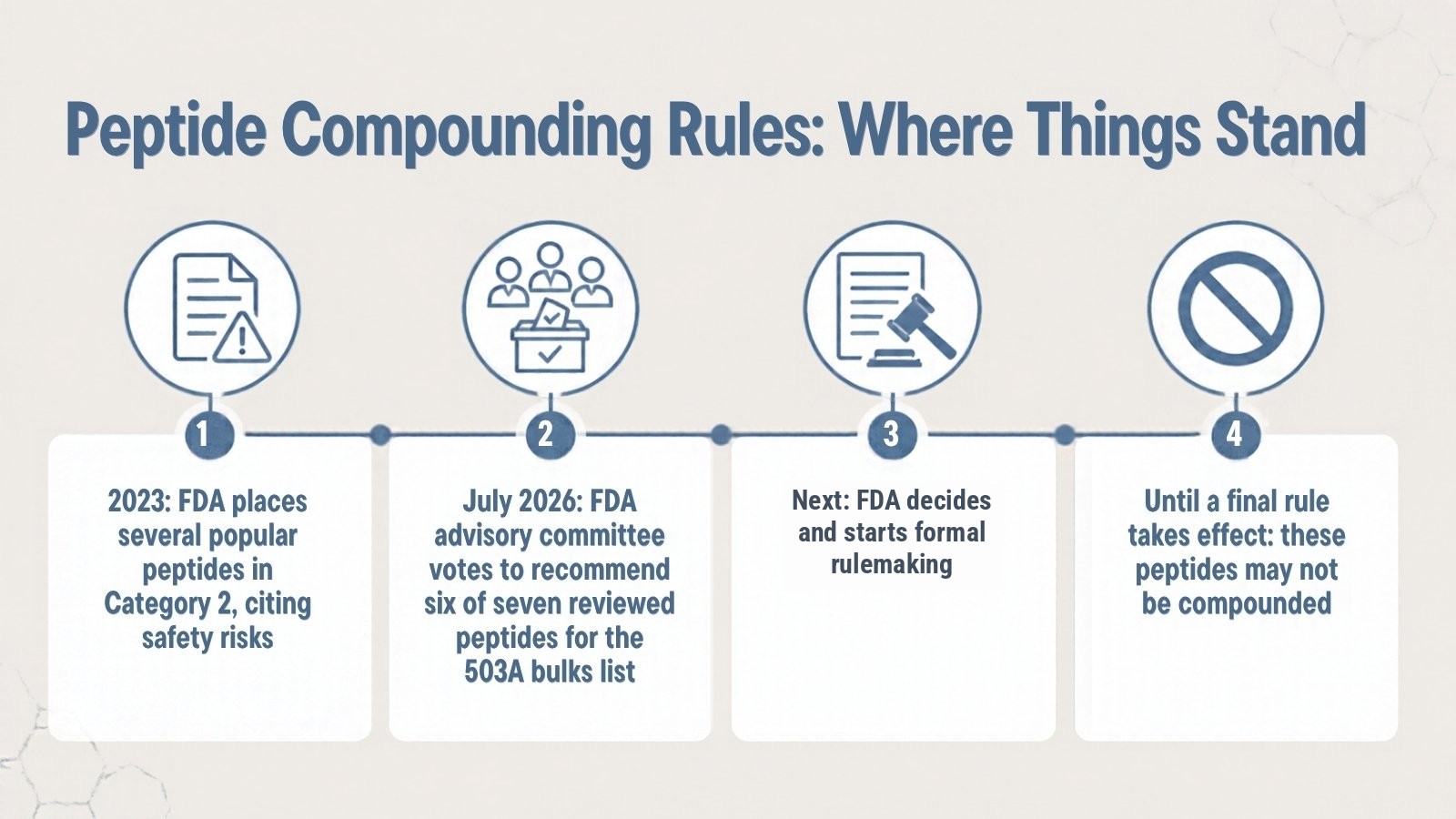
How compounding rules work
Under section 503A of the Federal Food, Drug, and Cosmetic Act, a compounding pharmacy can generally only use a bulk drug substance that is a component of an FDA-approved drug, has an official USP or NF monograph, or appears on FDA’s list of permitted bulk substances. FDA maintains information on bulk drug substances used in compounding under section 503A, including the categories it uses while it evaluates nominated substances.
2023: several peptides flagged for safety risks
In 2023, FDA placed a number of peptides popular in wellness settings into a category for substances that raise significant safety concerns. The agency’s page on bulk drug substances that may present significant safety risks in compounding describes concerns including possible immune reactions for certain routes of administration, impurities, and a lack of enough information to know whether the substances would cause harm.
July 2026: an advisory committee vote
On July 23 and 24, 2026, FDA’s Pharmacy Compounding Advisory Committee reviewed seven peptide substances nominated for the 503A list: BPC-157, KPV, TB-500, MOTS-c, emideltide (also called DSIP), Semax and Epitalon. FDA reviewers had written that there was a lack of evidence to evaluate the effectiveness and safety of these peptides. The committee’s votes were split, but it recommended adding six of the seven to the list. Emideltide was the one not recommended.
FDA’s briefing documents for related reviews show the level of scrutiny involved. For example, the agency’s published evaluation of CJC-1295-related bulk drug substances walks through physicochemical characteristics, historical use, effectiveness and safety concerns before reaching its conclusions.
What the vote does and does not mean
An advisory committee recommendation is advice to FDA, not a final decision. If FDA moves forward, it would go through formal rulemaking, which legal analysts have noted can take a long time. Until a final rule takes effect, pharmacies may not compound these substances. And even if they are eventually added to the list, that would allow compounding under specific conditions; it would not make them FDA-approved medicines or prove that they work.
For clients, the practical message is simple: headlines about “peptides being approved” are usually inaccurate. Ask for current, specific information from a licensed clinician or pharmacist.
Where the Human Evidence Is Strong, and Where It Is Thin
Peptide therapy is not one thing, so the evidence is not one thing either.
Strong: Approved peptide medicines such as insulin and GLP-1 based drugs have been tested in large randomized trials for specific conditions. Their benefits and risks are well described in their labelling.
Mixed but real: Collagen peptides, which are food-derived supplements rather than drugs, have a growing number of human trials with mixed findings for skin and joints.
Thin: Many wellness peptides discussed online have mostly laboratory and animal data, small or uncontrolled human reports, or no published human trials at all. The Peptides Blog’s review of what human evidence exists for BPC-157 is a good example of how wide the gap can be between online popularity and published human data.
This short FDA video explains the stages a medicine normally passes through before approval, which helps explain why so many popular peptides remain unproven:
Peptide Therapy Categories at a Glance
| Category | Example | Oversight | Typical evidence |
|---|---|---|---|
| Approved medicine | Insulin, semaglutide, tirzepatide | FDA review before marketing | Large human trials for specific uses |
| Investigational | Compounds in registered trials | Research oversight | Still being gathered |
| Compounded | Pharmacy-prepared versions of permitted ingredients | Not FDA-approved; ingredient rules apply | Depends on the ingredient |
| Food-derived supplement | Collagen peptides | Supplement rules; no pre-market approval | Some human trials, mixed results |
| Unclear status | “Research use only” vials | None for human use | Often lab and animal data only |
The Real Risks of Unregulated Peptides
When people talk about the risks of peptide therapy, they often focus on side effects of the molecule itself. With unregulated products, the bigger concerns may be about what is actually in the vial.
Identity and dose. Without regulated manufacturing, there is no guarantee that a product contains the stated peptide, in the stated amount, or nothing else.
Purity and contamination. Peptide synthesis can leave impurities, and FDA has cited impurities as one of its concerns with certain compounded peptides.
Sterility. Many wellness peptides are injected. Injectable products need sterile manufacturing and handling; a contaminated injection can cause serious infection.
Immune reactions. FDA has noted possible immune responses, known as immunogenicity, for certain peptides and routes of administration.
Interactions and underlying conditions. Without a clinician reviewing someone’s history and other medicines, important risks can be missed entirely.
These concerns are not hypothetical inconveniences; they are the reasons regulators require evidence and quality controls before medicines reach patients.
What Approved Peptide Treatment Looks Like
It can help clients to picture the contrast. When a licensed clinician prescribes an approved peptide medicine, the process typically includes a review of medical history and current medicines, a prescription for a specific product and dose, dispensing by a licensed pharmacy from regulated stock, written information about side effects and warnings, and follow-up to check how treatment is going. The medicine has known risks, but there is accountability at each step. That structure is worth wanting, and worth asking about, whenever peptides come up.
Where Coaching Fits, and Where It Does Not
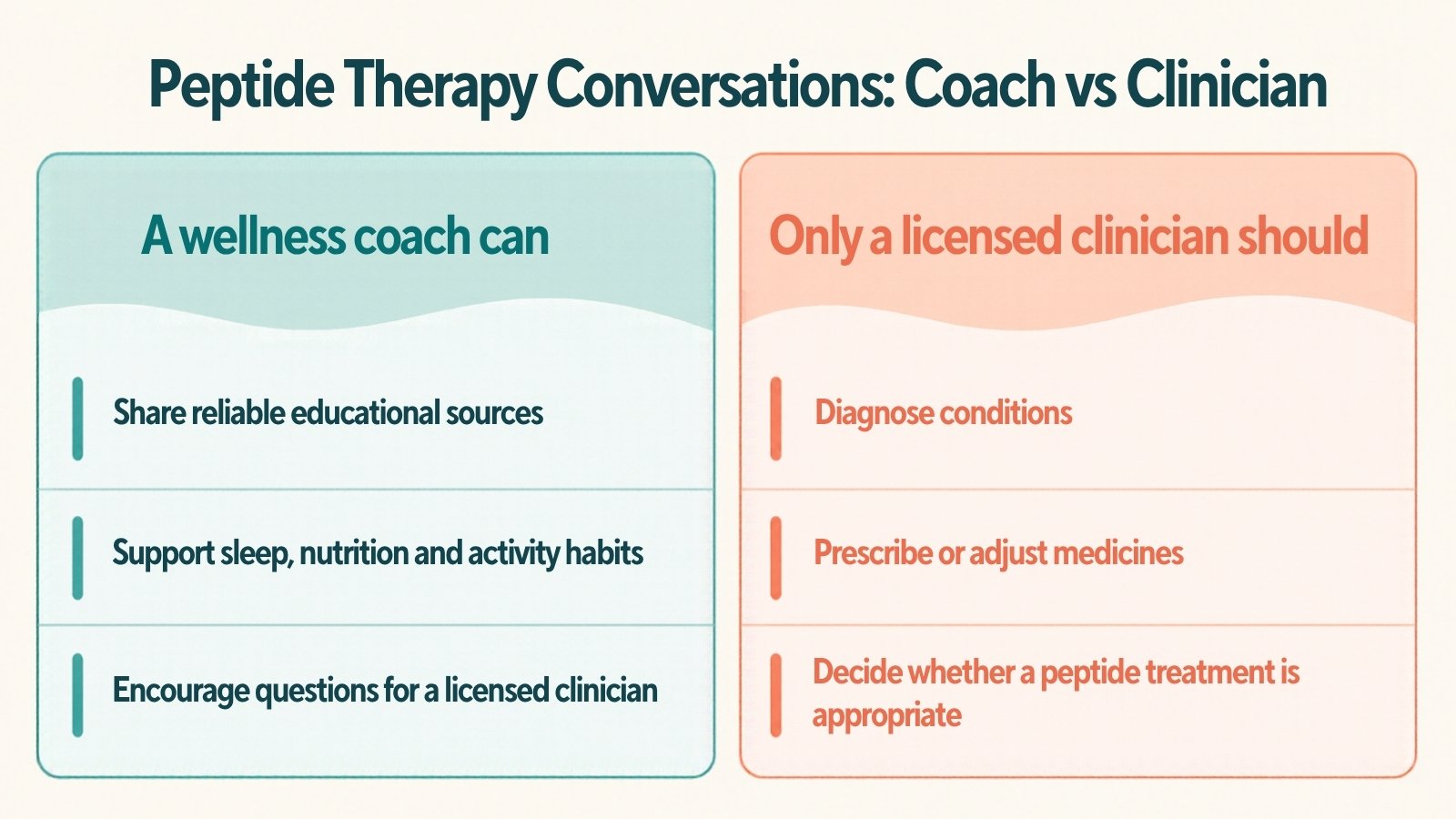
A good coach helps clients build habits, stay accountable and think clearly about their goals. As we describe in our overview of what a wellness coach actually does, coaching works alongside healthcare, not in place of it. That boundary matters a great deal with peptides.
Coaches can share reliable educational resources, help clients write down questions for their doctor, and support the foundations that drive most health outcomes: sleep, nutrition, movement, stress management and consistency. Coaches should not recommend specific peptides, suggest doses, help source products, or encourage anyone to use substances not prescribed by a licensed clinician. Doing so can put clients at risk and takes coaches well outside their scope of practice.
If a client is set on exploring peptide therapy, the most valuable thing a coach can do is help them prepare for an informed conversation with a qualified prescriber.
Questions to Help Clients Think It Through
Whether you are a coach or a client, these questions bring clarity quickly.
What exactly is the product? The specific name, manufacturer or compounding pharmacy, dose form and route.
What is it meant to do, and for whom? Is that use approved, being studied, or simply claimed?
What human evidence exists for this exact product and use? Not for a related molecule, a different form or an animal model.
Who is prescribing and monitoring it? A licensed clinician who knows the client’s history and other medicines.
What are the known risks, and what is unknown? For many wellness peptides, the honest answer to the second question is “a lot.”
Could the same goal be reached another way? Many goals people associate with peptides, such as better recovery, body composition or energy, respond strongly to sleep, training structure, protein intake and stress management.
A Simple Script for Talking to a Doctor About Peptides
Many clients feel awkward raising peptides with a doctor, especially if they expect disapproval. Having words ready helps. A client might say: “I’ve been reading about peptide therapy for [goal]. I’d like your honest view. Is there an approved treatment that fits my situation, and if so, what are the benefits and risks for me? If the peptide I read about isn’t approved, what evidence exists for it, and what would you suggest instead?”
That framing keeps the conversation focused on the client’s goal rather than a particular product, invites the doctor’s expertise, and makes it easy to explore approved options or non-drug approaches. Coaches can help clients rehearse this kind of conversation and write down the answers afterward.
The Foundations Still Do Most of the Work
It is easy to be drawn to a new compound promising faster results. But for most people, the biggest gains still come from consistent fundamentals. Seven or more hours of good-quality sleep, regular resistance and aerobic training, adequate protein, plenty of vegetables and fibre, limited alcohol, and practical stress management have strong, broad evidence behind them and no prescription required. Coaching is especially effective here, because these habits are simple to describe and hard to sustain without support.
Clients who build these foundations first are also better placed to judge any medical treatment their clinician recommends later, because they can see more clearly what is changing and why. You can browse more on habit change and accountability in our wellness coaching articles.
Goals People Link to Peptides, and Proven Ways to Pursue Them
Clients rarely want a peptide for its own sake. They want a result. Starting from the goal often opens up safer and better-supported paths.
Faster recovery from training. Sleep duration and quality, sensible training load, adequate protein and total calories, and planned rest days are the core levers. Persistent pain or slow-healing injuries deserve assessment by a physician or physical therapist.
Better body composition. Resistance training, protein intake spread through the day, a modest and sustainable energy deficit when fat loss is the aim, and consistency over months. For people with obesity, approved medicines prescribed by a clinician are an option backed by large trials.
More energy. Sleep, regular meals, hydration, physical activity, limiting alcohol, and checking with a doctor for treatable causes such as anaemia, thyroid problems or sleep apnea.
Healthy aging. Strength and aerobic fitness, social connection, not smoking, managing blood pressure, blood sugar and cholesterol, and regular preventive care have the strongest evidence for long, healthy lives.
Skin health. Daily sun protection, not smoking, a nutrient-rich diet and evidence-based skincare. Food-derived collagen peptides have some human data, with mixed results.
Framing the conversation this way often reveals that the client’s goal is very achievable without taking on the uncertainty of unproven compounds.
Red Flags When Clients Bring Up Peptides
The source is a seller. Information comes from a site or person that profits from the product.
No prescriber is involved. The plan involves ordering vials online and self-injecting.
“Research use only” labels. Products not intended for human use are being used by people.
Miracle promises. Claims of rapid healing, dramatic fat loss or reversed aging with no side effects.
“FDA approved” used loosely. Often a reference to an advisory committee vote or to a different, approved medicine.
When these show up, coaches can gently redirect clients to a licensed clinician and to reliable educational sources. The aim is not to shame anyone for being curious, but to make sure curiosity leads to a safe, well-informed decision.
Staying Current as Rules Change
Because peptide regulation is evolving, information that was accurate last year may not be accurate today. Coaches and clients can stay grounded by going back to primary sources when something changes: FDA’s own compounding pages, published committee documents and official announcements, rather than social posts summarising them. When a client hears that something “is now legal” or “just got approved,” the right response is to check exactly what changed, for which substance, and whether a final rule has actually taken effect. Independent educational sites that date their updates and link to the underlying documents are a helpful middle ground for people who do not want to read regulatory filings themselves.
Wrapping Up
Peptide therapy is a broad label covering everything from well-tested prescription medicines to unproven research compounds. The regulatory landscape for wellness peptides is moving, but a committee vote is not approval, and many popular peptides still have limited human evidence and cannot currently be compounded. For coaches and clients alike, the most useful approach is to stay curious, ask precise questions, keep medical decisions with licensed clinicians, and keep investing in the habits that reliably move health forward.
For balanced, sourced explanations of peptide science and regulation, explore peptide benefits and the research behind them at The Peptides Blog, a reference coaches can share with clients. It is an independent educational publication that does not sell peptides, provide treatment or offer consultations.
Frequently Asked Questions
What is peptide therapy?
It is the use of peptides, short chains of amino acids, as treatments. The term covers approved medicines, investigational compounds, compounded preparations and products with no clear regulatory status.
Are wellness peptides like BPC-157 approved by FDA?
No. BPC-157 is not an FDA-approved medicine. An FDA advisory committee voted in July 2026 to recommend adding it and several other peptides to the list of substances eligible for compounding, but that is not approval, and compounding is not permitted unless and until a final rule takes effect.
Can compounding pharmacies make peptide treatments now?
Only from permitted bulk substances. Several popular wellness peptides are not currently permitted, and the July 2026 committee recommendation does not change that until FDA completes rulemaking.
Can a wellness coach recommend peptides?
Coaches should not recommend specific peptides, doses or sources. They can share educational resources and help clients prepare questions for a licensed clinician.
Are “research use only” peptides safe to take?
They are not approved for human use and have no verified quality standards for people. Using them carries unknown risks.
Which peptide treatments have the strongest evidence?
Approved peptide medicines such as insulin and GLP-1 based drugs have been studied in large human trials for their specific approved uses.
Disclaimer
This article is for general education and does not provide medical, legal or regulatory advice. It does not recommend, endorse or provide sourcing for any peptide, medicine or supplement, and wellness coaching is not a substitute for care from a licensed healthcare professional.
Regulatory status described here reflects publicly reported information and may change. Peptide medicines should only be used as prescribed by a licensed clinician and dispensed by a licensed pharmacy. Laws and approvals differ by country and state. Consult a qualified professional about your individual situation.

Phillip Fernandez
More articles by this author